






The music of Cuba: A history lesson
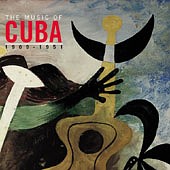 It`s getting hard to find anyone outside of Miami who seriously considers Cuba a red menace these days. In fact, the island country to our south has been getting some favorable press as of late. There was the success of the "Buena Vista Social Club" documentary and the popularity of the albums put out by the Afro-Cuban All Stars. And nonmusically speaking, well, they did send Elian back home.
 Certainly, Cuba is in style. Add in the popularity of the Latin-music craze perpetuated by the likes of Carlos Santana, Ricky Martin and Marc Anthony, and the time is right for "The Music of Cuba 1909-1951," Columbia`s collection of 25 original recordings from pre-Castro Cuba. In a 25-song span, the collection traces the maturation of such Latin styles as the conga, rumba and son, and it does much to whet your appetite for fast-paced, percussion-heavy rhythms. Most of the earlier tracks on the album function mainly as historical context (a few recordings are disturbingly scratchy), though one son from 1919 by Floro Zorrilla and Miguel Zaballa is an amazingly mature-sounding rhythm that explodes with lively percussion and smoothly woven horns.
It`s the songs from the mid-1930s, however, that make this CD come alive. By that time, Cuban groups had become adept at fusing American-inspired big-band brass sounds with more traditional Latin stylings. Exemplar of this is the richly orchestrated conga recorded in 1936 by Augusto Coen and his Golden Casino Orchestra, a delicious-sounding, fast-paced delight of bongos and claves nicely blended with more traditionally American reed instruments. And then there`s "Tabu" a playfully sexy rumba by the Lecuona Cuban Boys recorded in Paris in 1936, which features some seriously devilish clarinet playing.
The spectacular selection from the late 1930s is further enriched by a selection of two congas from Desi Arnaz. Detailed liner notes, explaining the origins of each track, penned by Dick Spottswood, add historical context to the listening experience. As the album closes with "Como Ayer" by Conjunto Cubakonga, you`re left pleasantly poised mid-century, anticipating salsa music and wondering what Cuba could`ve had to offer if Castro hadn`t come to town.
"Faith and Courage"; Sinead O`Connor; Atlantic.
Sinead O`Connor`s bald head, brazen stunts and powerful voice paved the way for the emergence of female artists throughout the 1990s from Liz Phair to Courtney Love to Alanis Morissette. Isn`t it ironic, then, that these artists make O`Connor`s loud feminist rants sound outdated? "Faith and Courage," O`Connor`s first album in six years, doesn`t come close to achieving the brilliance of her best work, 1990`s "I Do Not Want What I Haven`t Got." Nor does it go far in re-establishing O`Connor as a singer-songwriter worth paying attention to.
The album lands in the reject pile for a few reasons. First, there`s the not-so-subtle title, then there are O`Connor`s simplistic and utterly predictable lyrics, and finally there`s the stale pop sound that about half these songs falter under. Though intermittently sprinkled with flashes of experimentation, "Faith and Courage" fails to bring anything original to the table and serves mainly to remind us that O`Connor is a strong and independent woman. However, unlike the lyrics of Fiona Apple or Liz Phair, you never get a sense of what`s going on behind O`Connor`s tough-girl mask. So ultimately the image she presents rings false.
The first single off the CD, "No Man`s Woman," is typical O`Connor. In it, she predictably asserts, "A man can fake you/take your soul and make you," with typical male bashing. In "Daddy`s Girl," she laughably rhymes: "I was born in Dublin town/where there was not too much going down." Worse, these lyrics are delivered on top of a heinous pop sound perpetuated by a tinny drum machine that constantly battles with O`Connor`s voice for audibility.
Though the second half of the album moves away from this style, it doesn`t go far enough to compensate. Interestingly, although O`Connor hammers her independence over your head, the best cuts on the album are penned by (gasp!) men. "The State I`m In," written by Scott Cutler, captures O`Conner`s richly layered and frighteningly emotional voice better than any other cut on the album. (Note: "Nothing Compares 2 U," penned by Prince, was Sinead`s most well-known track.) Furthermore, the feisty Irishwoman gathered together a prestigious production team, which includes the likes of Wyclef Jean and David Stewart. In the end, though, no man could help turn this album into a keeper.
(c) Copley News Service
advertisement

Author: Emily Friedlander
Archives
Leroy - remember his name
A multiethnic musical tour
No translation required
10 best guitar solos of all time
Animated music to keep you animated
Janet, is that all there is?
Dave Matthews` new sound gets old
The ideal record store
Limp Bizkit is still angry at everything
Radiohead shakes things up
Bjork`s at her quirky best on `Selmasongs`
Madonna`s `Music` is a copy of a copy
`Volumizer` a breath of fresh beats
Fugee this, Fugee that
Morcheeba: Hip-hop meets disco
More Articles